
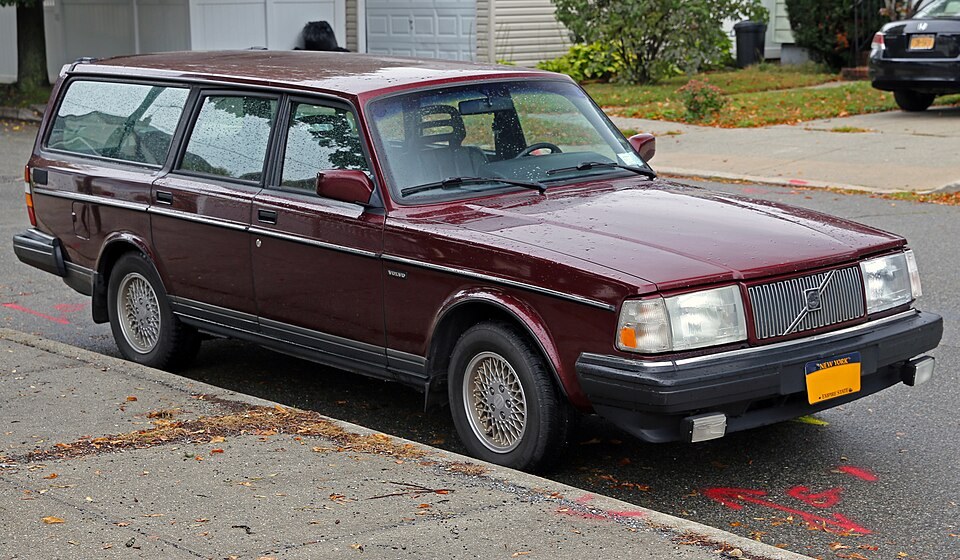

What is a station wagon?
A station wagon is a passenger car whose roof extends over a substantial rear cargo compartment, with a rear hatch or tailgate and flexible passenger-and-luggage space. In British usage, the same general body style is an estate car. The defining idea is extra usable space along a car-like body, not simply a tall vehicle with a rear hatch.
The boundaries are imperfect. A hatchback may offer similar flexibility with a shorter cargo area; a crossover typically adds a taller body and seating position. Raised wagons sit between those categories. EPA vehicle classes, manufacturer branding and enthusiast vocabulary do not always draw the line in the same place.
Why the wagon exists: it lets one passenger vehicle carry people and bulky belongings without separating them into a sedan’s enclosed trunk. The original railway-transfer job evolved into family transport, work, leisure and performance motoring.
Explore the specialist long roofs: the Treser Audi 200 Liner, Arden AJ3 and Lynx Eventer are covered in our Rare & Forgotten Wagons collection, alongside a clearly labeled LM002 coachbuilt SUV special feature.
Railway stations gave the wagon its job—and its name
Early station vehicles carried travelers and baggage between rail depots, hotels and resorts. Their cargo capacity mattered more than a fashionable silhouette. The American “station wagon” name preserved that transport role; “depot hack” described the same working world. The Audrain Automobile Museum traces “hack” to hackney, a vehicle used for hire.
Many early motorized examples were not a single factory-designed model. Independent coachbuilders fitted practical bodies to existing chassis. Audrain’s 1922 Ford Model T Depot Hack shows how a familiar, serviceable car platform could become passenger-and-luggage transport. Wood was accessible and comparatively straightforward for small workshops to shape.
That history is why there is no especially useful single-inventor answer. Coachbuilt utility bodies evolved before the wagon became a standardized catalog product. By the Model A era, Ford offered a regular station wagon, bringing the idea further into factory production. Source: Audrain’s depot-hack history.
Woodies: a construction method before a style
The earliest wood-bodied wagons wore timber because it formed part of the body itself. Joints, panels, varnish and weather protection were ownership necessities, not cosmetic extras. The exposed framework later became a recognizable image of leisure, but many early examples were working vehicles.
Steel changed the production and maintenance equation. Willys introduced its steel-bodied Station Wagon in July 1946, with painted sections suggesting wood. Four-wheel drive followed in 1949. It is a landmark in the move toward durable, mass-produced utility bodies, although claims about the “first all-steel wagon” depend on whether truck-derived vehicles are included. Source: Jeep’s Willys history.
Structural wood and decorative woodgrain must not be confused. On a later steel-bodied wagon, simulated wood trim may be a styling treatment; on a structural woodie, the timber can be fundamental to body integrity. The difference still determines restoration skills, storage needs and inspection priorities.
The family-road-trip era
As car travel and suburban life expanded, the wagon offered a useful compromise: everyday passenger accommodation plus enough flexibility for shopping, luggage and holiday equipment. The Smithsonian’s transportation history connects automobiles with the development of suburbs, while the AACA Museum’s wagon exhibition follows the body style from station transfers into family travel. Neither requires an invented sales statistic to explain its cultural importance. Smithsonian: America on the Move; AACA Museum: Tailgate Travelers.
By the mid-century family-wagon era, usefulness could also be expressive. Long bodies, broad rear openings, distinctive roof glass, decorative woodgrain and folding extra seats made utility visible. Tailgate design became part of the ownership experience: loading groceries, accessing luggage and accommodating long objects all asked different things of the rear opening.
The nostalgia needs a safety boundary. Historic photographs of children riding in cargo areas are not guidance for using a classic today. Verify actual seats, restraints and applicable child-seat requirements; luggage space is not a passenger seat.
Why European estates developed an enduring identity
The wagon was not exclusively an American family symbol. European manufacturers developed estates as practical extensions of passenger-car ranges. The same idea could serve trades, households, long-distance travel or professional use, while a car-like footprint remained important.
Volvo provides a well-documented example. Independent body firms used the PV445 chassis for several types of vehicle before Volvo introduced its Duett variant in 1953. The 245 estate, presented as part of the 240 family in 1974, continued into 1993. Its long roof and flexible interior made utility an enduring brand characteristic rather than a passing trim package. Volvo Duett history; Volvo 245 history.
Regional naming also matters. A shopper looking only for “station wagon” can miss an estate, Kombi or break, as well as a manufacturer’s Touring, Avant or Variant badge. Those words describe overlapping ideas, not identical equipment or universal body classifications.
Why American buyers shifted to minivans and SUVs
Wagons did not disappear because their basic job vanished. Competing body styles offered other ways to do that job. Chrysler’s 1984 model-year minivans established a major family-vehicle alternative, with a taller cabin organized around passengers and flexible seating. Chrysler’s own history records that product milestone. Source: Chrysler history.
The broader market shift unfolded over time. Minivans emphasized interior packaging and access. SUVs appealed through height, utility and an adventure-oriented image; later crossovers brought much of that appearance to car-based platforms. These are explanations of the competing propositions, not a claim that every SUV tows more or every wagon handles better.
The result was not the same everywhere. Traditional American family wagons became less central, while estates continued within European product ranges and imported premium wagons maintained a U.S. audience. Avoid the tidy myth that one vehicle “killed” the wagon overnight: household needs, vehicle availability and cultural preferences changed together.
Performance estates changed the meaning of practical
Fast wagons did not begin with the Audi RS2. Volvo presented a turbocharged 245 estate in 1981, well before the 1990s performance-estate icons. Practical packaging and stronger performance were already compatible. Volvo’s 245 archive.
Audi and Porsche jointly developed the RS2, produced in 1994–1995. It was the first Audi RS model, not the first fast station wagon. Its significance was the deliberate combination of estate practicality and a highly developed performance package. Audi’s RS6 lineage began in 2002 and carried that theme across successive generations. Audi RS2 history; Audi RS6 retrospective.
Volvo made an unusually public statement by racing an 850 estate in the 1994 British Touring Car Championship. The shape itself became memorable advertising for the idea that a wagon need not be dull. It is important not to rewrite that participation as a championship win by the estate. Volvo 850 Estate history.
For buyers, this branch of the family tree brings different obligations. Tires, brakes, cooling, drivetrain condition and specialist access may matter more than the fact that the car has a large hatch. The body style alone says little about running costs.
Electric wagons continue the idea
Electrification changes propulsion without making the long roof obsolete. Volkswagen explicitly describes the ID.7 Tourer as an all-electric estate. It is a contemporary example of the wagon’s basic proposition continuing with a different energy system. Source: Volkswagen ID.7 Tourer.
Battery packaging, charging access, load limits and measurement methods create new comparisons for buyers. A large exterior does not guarantee a particular cargo shape, and an overseas estate is not automatically available or eligible for registration in the United States. For model research, separate an international example from a verified U.S.-market configuration.
The lasting point is not that wagons are universally better than SUVs. It is that a low passenger-car roof extended over useful cargo space remains a distinct solution. Some buyers value that combination enough to seek it out deliberately.
What different countries call station wagons
These are common shopping terms, not universal legal definitions. Regional language, individual manufacturers and enthusiasts overlap.
| Term | Where or how it is used | What to remember |
|---|---|---|
| Station wagon / wagon | North America, Australia and New Zealand | A general body-style term; the station refers to its railway-transfer origins. |
| Estate / estate car | Britain and Ireland | Normally the same general body style as a station wagon. |
| Kombi | Common German and Swedish usage | A passenger-and-cargo association; local usage is broader than one exact silhouette. |
| Break | French usage | Often the estate version of a passenger-car range. |
| Familiare / giardinetta | Italian terminology | Historical and manufacturer usage varies; not a guarantee of seating capacity. |
| Longroof / long roof | Enthusiast slang | A visual nickname, not a certification or official vehicle class. |
| Woodie / woody | Construction and styling nickname | Distinguish structural timber from simulated woodgrain on a steel body. |
| Shooting brake | Historic sporting coachwork and modern marketing | Overlaps with sporty estates, but is not an exact synonym for every wagon. |
| Family car / family hauler | A role rather than a body style | Can describe wagons, sedans, MPVs or SUVs. |
Brand names are another layer: Audi Avant, BMW Touring, Volkswagen Variant, Saab SportCombi and Jaguar Sportbrake are manufacturer terms. Cross Country and All-Terrain describe particular interpretations; do not infer drivetrain, ground clearance or capability from a generic wagon label.
A compact station-wagon timeline
| Period | Milestone | Why it matters |
|---|---|---|
| Early 1900s | Depot hacks and coachbuilt bodies | The job of carrying passengers and luggage precedes a standardized model. |
| Model A era | Factory-catalogued Ford wagon | The coachbuilt idea moves toward regular production. |
| 1946 / 1949 | Willys steel wagon / four-wheel-drive version | A durable utility body connects wagon and all-weather transport. |
| 1953 | Volvo Duett | A lasting European passenger-and-cargo lineage. |
| 1974 / 1981 | Volvo 245 / turbo estate | Everyday estate utility and performance develop together. |
| 1984 model year | Chrysler minivans | A significant alternative for family-car packaging. |
| 1994 | Audi RS2 and Volvo 850 estate in BTCC | The practical body earns a stronger enthusiast identity. |
| 2000s onward | Modern performance and all-road estates | The shape remains useful within increasingly specialized ranges. |
| 2020s | All-electric estates such as ID.7 Tourer | The longroof concept continues beyond combustion engines. |
Milestones are selected examples, not a complete list of manufacturers or a claim of global firsts. Supporting sources appear in the corresponding sections above.
Station-wagon history: common questions
Why is it called a station wagon?
The name comes from carrying passengers and luggage to and from railway stations. Early depot hacks were practical transfer vehicles before the body style became a family-car staple.
Is an estate car the same as a station wagon?
In ordinary modern usage, yes. Estate is common British terminology, while station wagon or wagon is common in North America. Manufacturer labels and regulatory categories can differ.
Were all woodies made of wood?
Early woodies used timber as part of the body construction. Later steel-bodied wagons often used decorative woodgrain. A visual wood treatment does not establish structural timber.
Did SUVs make wagons disappear?
No. American family buyers shifted toward minivans, SUVs and crossovers over time, but estates continued in other markets and in specialist performance and premium ranges.
Are station wagons still relevant?
Yes. The long-roof passenger-car format remains a distinct way to combine people and cargo. Performance and all-electric estates illustrate its continuing development, although availability varies by country.
How this history is sourced
Waghoon uses museum collections and manufacturer archives for dated milestones. The interpretation connecting those events is editorial synthesis. We avoid unsupported production totals, disputed global “firsts” and invented market-share claims. Terminology is a practical glossary, not a legal classification system.
Sources are linked beside the claims they support. Read our editorial policy or suggest a correction with a source.