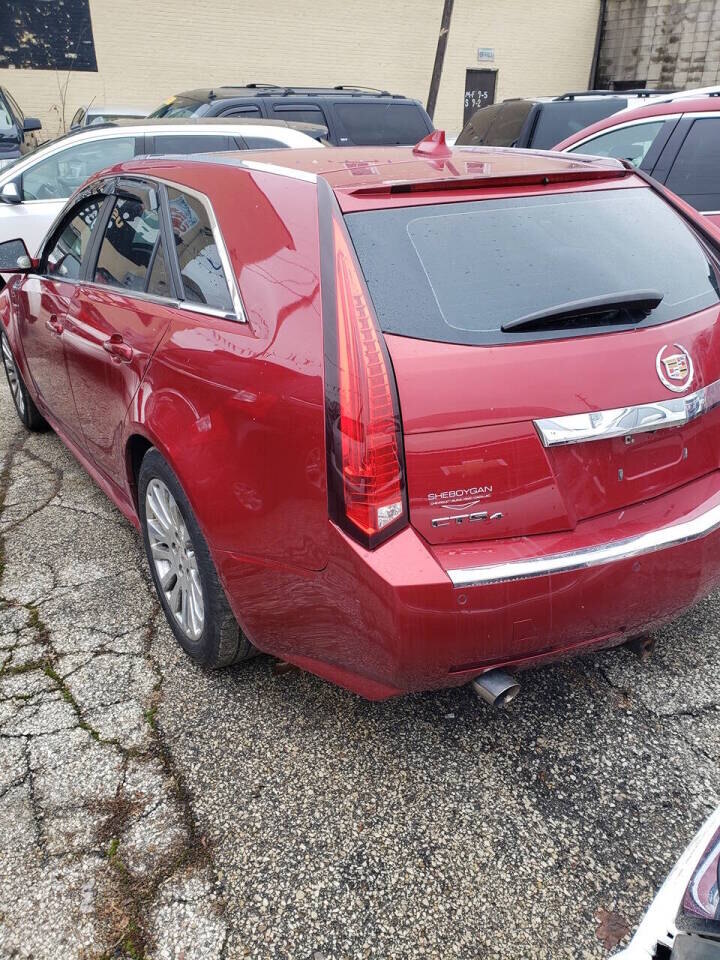
The V6 CTS Sport Wagon and CTS-V are different ownership propositions. The documented V6 wagons offer an automatic and a choice of rear- or all-wheel drive. The CTS-V uses a supercharged V8 and rear-wheel drive, with manual or automatic transmissions. A 3.6 badge also needs a year: the examples below show why its horsepower figure is not universal.
Scope: U.S. factory specifications from Cadillac’s 2011 CTS, 2014 Coupe/Sport Wagon and 2014 CTS-V brochures. These are explicit reference years, not a claim that every CTS body style or year has the same specification.
The engine comparison needs a model-year column
| Reference wagon | Engine / output | Drive | Transmission |
|---|---|---|---|
| 2011 CTS Sport Wagon 3.0 | 3.0L V6 / 270 hp | RWD or AWD | 6-speed automatic |
| 2011 CTS Sport Wagon 3.6 | 3.6L V6 / 304 hp | RWD or AWD | 6-speed automatic |
| 2014 CTS Sport Wagon 3.0 | 3.0L V6 / 270 hp | RWD or AWD | 6-speed automatic |
| 2014 CTS Sport Wagon 3.6 | 3.6L V6 / 318 hp | RWD or AWD | 6-speed automatic |
| 2014 CTS-V Wagon | 6.2L supercharged V8 / 556 hp | RWD | 6-speed manual or automatic |
Sources: 2011 CTS brochure, 2014 Coupe/Sport Wagon brochure and 2014 CTS-V brochure. Use wagon-specific specifications; a generic CTS lookup may return a sedan or coupe.
Why the ordinary 3.6 belongs on a sporting-wagon shortlist
The 3.6 V6 gives you a distinct alternative to the CTS-V: more output than the same-year 3.0 reference without committing to the V model’s supercharged-V8 specification. It also leaves an AWD option in the documented V6 range.
That can be the more relevant combination if your priority is a distinctive daily-use wagon with room for luggage rather than a particular V8 or manual-transmission experience. It does not mean the 3.6 is automatically the cheapest car to maintain or the best example on the market.
Drive both V6 candidates on the same kind of route and compare their actual condition. The engine label cannot tell you whether tired suspension, tires or unresolved faults will dominate your experience.
Manual transmission and AWD point to different choices
If a factory manual is central to the purchase, the CTS-V is the relevant wagon in these documents. Do not take a manual-transmission reference from a CTS sedan brochure and attach it to a V6 Sport Wagon advertisement.
If AWD is essential, the documented V6 models provide that choice; the CTS-V reference is rear-wheel drive. An advertisement that appears to combine “CTS-V,” “AWD” and “manual” warrants careful identity checks rather than excitement about an extraordinary factory configuration.
Confirm the VIN, build information, photographs and the actual hardware. Badges and database dropdowns are not enough, particularly if the seller reports a conversion or extensive modifications.
What changes when you choose CTS-V
The V adds more than peak output. Cadillac’s V-Series brochure describes Magnetic Ride Control and Brembo braking hardware alongside the supercharged engine. Those components should be identified and assessed in an inspection, then included in the ownership estimate.
For a manual, ask the inspector to evaluate clutch operation and the gearbox. For either transmission, ask about software, pulleys, intake, exhaust and other modifications. Request the documentation for the car as it exists now, not only a list of original factory features.
Choose the V because you want that specific driving and mechanical proposition. If the ordinary V6 already meets your needs, a larger repair reserve alone will not turn extra performance into something you use.
Timing chains: use documented guidance, not a blanket verdict
GM published timing-chain service guidance covering specified High Feature V6 applications and fault codes including P0008, P0009 and P0016–P0019. Its tables include CTS applications, but applicability depends on the model year, engine and build details.
That is a reason to ask informed inspection questions. It is not a failure-rate study, proof that every 3.6 will fail, or evidence that an individual car needs a chain replacement. A code by itself is not a complete diagnosis.
Ask a qualified shop to review the exact engine’s current service information, scan the car, assess any symptoms and examine the maintenance and repair invoices. If timing work has been done, an invoice identifying the parts and labor is more useful than a seller’s phrase such as “chains sorted.”
We do not label the 3.0 universally more reliable than the 3.6. Making that claim would require comparable failure data by year, engine and use, which this guide does not have.
CTS-V noise needs the right diagnosis
A separate GM bulletin, PIP5192A, discusses a specific low-rpm supercharger buzz or rattle on listed LSA/manual-transmission applications. The document explains that the particular condition it describes can be normal.
This illustrates why “I heard a noise” is not a sufficient purchase diagnosis. Have the workshop identify when it occurs, whether the bulletin applies and whether newer service guidance changes the assessment. Do not use this historical document to dismiss every supercharger noise or authorize parts replacement without diagnosis.
For a prospective purchase, ask for the written finding and any repair estimate. You need to understand the condition of that engine, not win an argument about the reputation of all CTS-Vs.
The wagon-specific checks still matter
Cadillac’s 2014 V6 Sport Wagon brochure lists 25 cubic feet with the rear seats up and 58 with them down. Verify your own load instead of assuming that the maximum figure represents a family trip with all seats occupied.
Inspect the tailgate, rear glass area, load floor, folding seat mechanisms, roof openings if fitted, and the completeness of cargo covers and restraints. Test the items you will use every day. A strong engine does not compensate for a hatch that will not operate correctly or a load compartment that does not fit your equipment.
Check VIN-specific recall status and use an independent inspection. Recall completion, service-bulletin applicability and ordinary wear are different questions; none replaces the others.
A practical way to choose
Consider the 3.0 when the actual car’s condition, documentation and total purchase budget make it a good fit, and its performance meets your needs. Consider the 3.6 when you want the stronger V6 specification and the possibility of AWD. Consider the CTS-V when the supercharged V8 or factory manual is a central reason for owning the car.
Keep repair reserves tied to quotes for the candidate’s actual equipment and findings. This guide supplies the distinctions needed for a shortlist; it does not invent a current market average, a production rarity count or a universal ownership-cost winner.
Questions buyers ask
Is every CTS 3.6 wagon rated at 318 horsepower?
No. Cadillac’s 2011 brochure lists 304 hp for the 3.6 Sport Wagon, while its 2014 brochure lists 318 hp. Use the exact model-year document.
Did the V6 CTS Sport Wagon have a factory manual?
The 2011 and 2014 U.S. V6 wagon references here specify a six-speed automatic. The CTS-V Wagon offered a factory manual. Do not apply sedan transmission options to the wagon.
Is the CTS-V Wagon AWD?
The documented 2014 U.S. CTS-V Wagon is rear-wheel drive. AWD is an option in the V6 Sport Wagon range discussed here.
Is the 3.0 safer to buy than the 3.6 because of timing chains?
This guide does not establish a model-wide reliability winner. Have a specialist verify the exact engine, applicable service guidance and condition, and assess the car’s documented maintenance.
Sources and editorial method
Manufacturer brochures establish the reference specifications. GM bulletins hosted by NHTSA support narrowly scoped inspection questions; they are historical service information, not recalls, prevalence estimates or diagnoses. Use current service information for the actual VIN. This article is desk research, not a road test.
- Cadillac 2011 U.S. CTS brochure — Sport Wagon section distinguishes 270-hp 3.0 and 304-hp 3.6 V6s from the CTS-V.
- Cadillac 2014 U.S. CTS Coupe and Sport Wagon brochure — Sport Wagon specifications, V6 output and available AWD; not the redesigned 2014 sedan.
- Cadillac 2014 U.S. CTS-V brochure — Supercharged V8, transmissions and V-specific chassis hardware.
- GM service bulletin: High Feature V6 timing-chain kits and guide replacement — Historical manufacturer bulletin hosted by NHTSA. Applicability is limited by model, year, engine and build details; a service bulletin is not a failure-rate study.
- GM PIP5192A: supercharger rattle or buzz — September 2014; specific LSA/manual-transmission applications. Use current service information for diagnosis.
- NHTSA: vehicle recalls — Check the individual VIN; model reputation does not establish recall completion.
- FTC: buying a used car from a dealer — Consumer guidance including independent inspection and written purchase terms.