

A 456 from the front, an estate from the rear
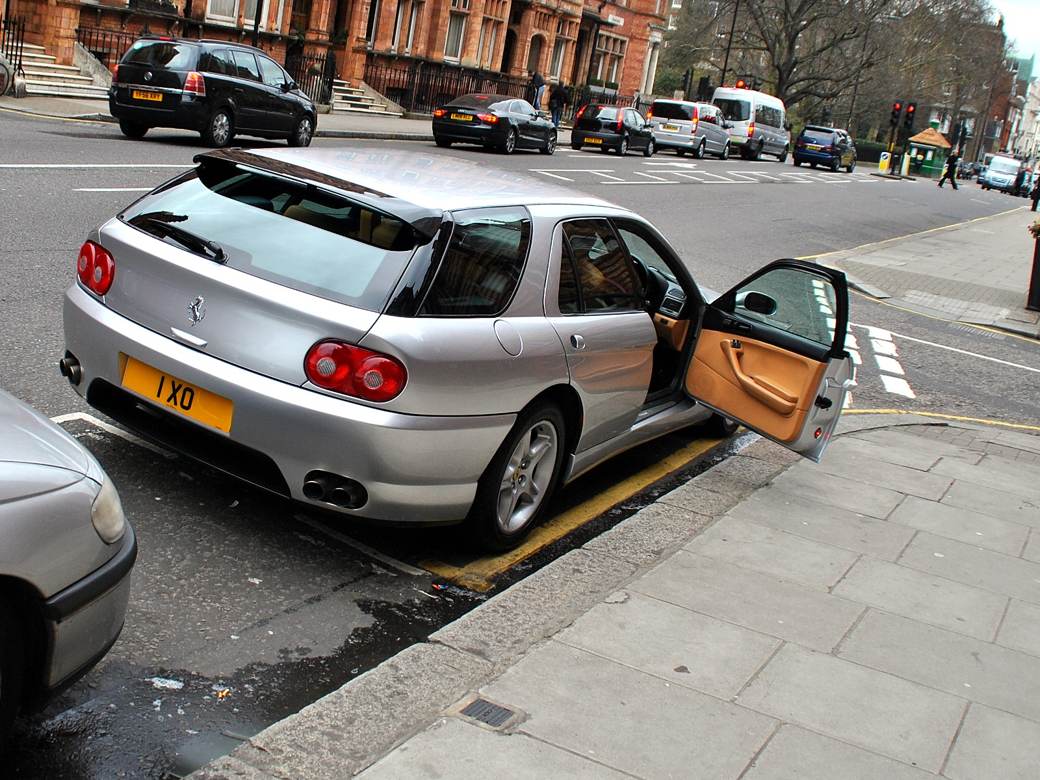
The photograph from The Quail gives the game away halfway down the car. Ahead of the windshield are the familiar 456 hood and pop-up headlamps. Follow the side glass rearward and a second door handle comes into view, followed by a deep quarter window. At the tail, round Ferrari lamps flank a top-hinged liftgate. Taken together, those details explain the Venice better than its badge does. Pininfarina took a front-engined Ferrari grand tourer and gave its rear passengers their own doors and its luggage a separate way in.
The project grew out of Pininfarina’s work for the Brunei royal family in the 1990s. The estate was one body style in a commission that also included four-door sedans and open 456s. In a 2002 account for the Ferrari Owners’ Club, historian Keith Bluemel described standard right-hand-drive cars leaving Ferrari’s factory in Maranello and going to Pininfarina in Turin for conversion. His account records a 200 mm (7.9 in) extension to the chassis rails to make room for the four side doors. That is a documented chassis modification. It gives us no basis for assigning a cargo capacity to the wagon.
Why the extra doors were an engineering project
Adding rear doors meant making a longer car that could still shut, seal and cool properly. In an interview with WhichCar, Pininfarina engineer Paolo Garella recalled redesigning the door system and making substantial chassis and gearbox changes for the estate and sedan. He also described the demanding air-conditioning requirements of the Brunei projects and the team’s hot-weather and water-durability testing.
Bluemel recorded a 5.5-liter V12 and automatic gearbox for chassis 103190, a 1995-model donor that Pininfarina converted in 1996 and delivered directly to England. Garella recalled adapting a Porsche 928 transmission for the broader 456 program before Ferrari offered its own automatic. That interview explains how the team solved an early engineering problem. The gearbox fitted to an individual Venice still needs chassis-specific documentation.

How many Venice wagons were built?
Published accounts put the estate run at six or seven. Carrozzieri Italiani identifies four estate chassis in its register and records the disagreement between the six- and seven-car accounts. That leaves a documented subset and an unresolved production total. Garella’s recollection of 42 cars refers to the broader 456 program for Brunei, which covered several body styles.
For a collector, the useful questions begin with the individual car. Which Ferrari chassis went to Turin? When was it converted? Which panels, glass and interior pieces survive from the original work? Photographs show what the wagon looks like. A chassis record, period registration and conversion documentation can establish much more about how it got there.
What Pininfarina got right
The Venice is interesting because its wagon body changes how you use the car without erasing the 456’s proportions. The long hood is still the first thing you see. The extra side glass and rear doors sit under a low roof, and the liftgate ends at the original visual signature of four round lamps. That restraint is part of the achievement. Pininfarina gave the grand tourer a practical second job and made the result look like it belonged in the family.
See how another coachbuilder solved the same roofline problem in the Lynx Eventer Jaguar XJS or explore the Rare & Forgotten Wagons collection.
Sources
- Keith Bluemel, Ferrari no. 134 (2002), reproduced by the 330 GT Register, for the construction and chassis 103190.
- Paolo Garella interview, WhichCar, for firsthand recollections of Pininfarina’s development work and the Brunei 456 program.
- Carrozzieri Italiani history and chassis register, for the known estate chassis and conflicting published totals.