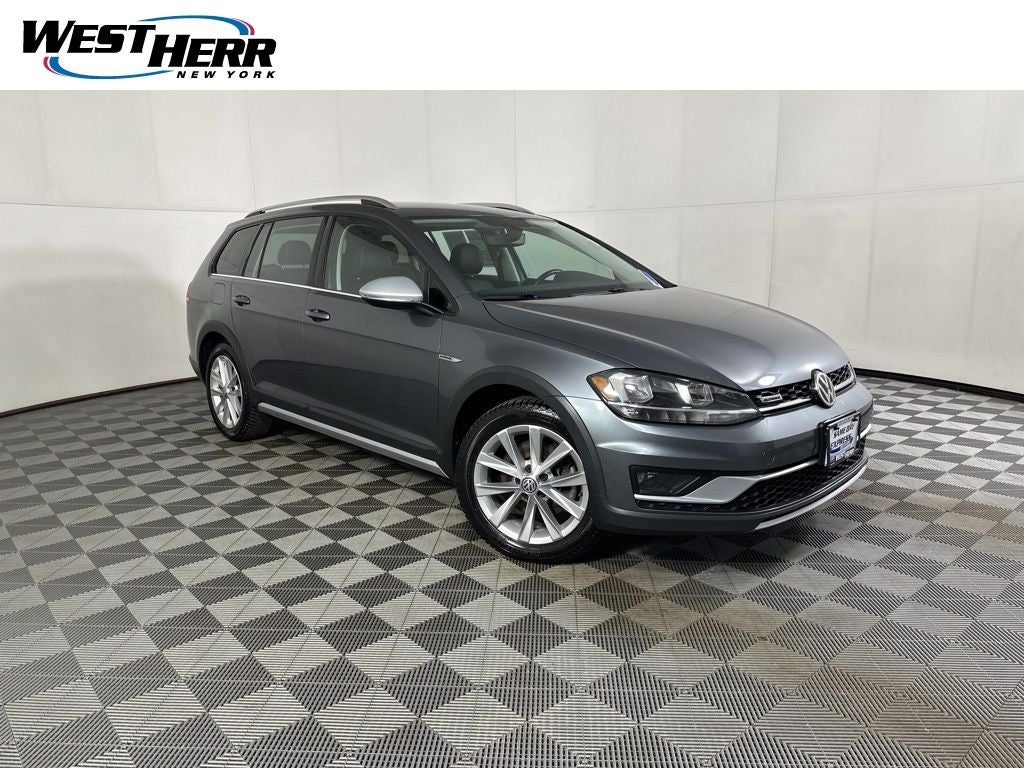
The 2019 U.S. Golf Alltrack and Golf SportWagen each have a published 30.4 cubic feet behind the rear seats and 66.5 with them folded. Alltrack adds standard 4Motion AWD and increased clearance. SportWagen is not automatically front-wheel drive: the S 4Motion is an important alternative. Compare it separately from the 1.4-liter front-drive SportWagen.
Scope: factory-stock 2019 U.S. configurations. Earlier cars, Canadian-market trims, diesel SportWagens and modified cars need their own checks. Cargo figures come from Volkswagen’s two model-specific press kits.
Compare the three configurations, not just two names
| Factory specification | SportWagen FWD | SportWagen S 4Motion | Alltrack |
|---|---|---|---|
| Engine / output | 1.4L turbo / 147 hp | 1.8L turbo / 168 hp | 1.8L turbo / 168 hp |
| Drive | Front-wheel drive | AWD | AWD |
| Gearboxes offered | 6-speed manual or 8-speed automatic | 6-speed manual or 6-speed DSG | 6-speed manual or 6-speed DSG |
| Cargo: seats up / folded | 30.4 / 66.5 cu. ft. | 30.4 / 66.5 cu. ft. | 30.4 / 66.5 cu. ft. |
| Primary distinction | Front-drive 1.4T combination | AWD without Alltrack’s raised presentation | 6.9-in. clearance; raised ride height and specific trim |
Sources: 2019 SportWagen press kit and 2019 Alltrack press kit. Availability of an option within the range does not prove it is fitted to a particular car. Read its build documentation.
Does the Alltrack have more cargo space?
No, not by Volkswagen’s published 2019 volumes. Both offer the same numbers with the rear seats in use and with them folded. The Alltrack’s raised stance is a separate feature, not evidence of a larger luggage compartment.
This makes cargo-only shopping simpler: you can assess both versions with the same packing task. Bring the largest object you carry. Test it with the rear seats occupied, check that the hatch closes without pressing on the load, and see whether the cargo cover still works. A maximum folded-seat figure tells you little about a family trip with people in the back.
Volume also cannot tell you whether a bicycle fits with its wheel attached or a dog crate passes through the hatch. Photograph your actual test so the next car can be assessed in the same way.
You can get AWD and a manual without choosing Alltrack
The SportWagen S 4Motion deserves its own search. It combines the 1.8-liter engine with AWD and was offered with a six-speed manual or DSG. Looking only for Alltracks can therefore exclude a configuration that meets the same transmission and drivetrain requirements.
For 2019, Volkswagen also expanded the Alltrack manual to every trim. That does not make all examples manuals; verify the pedals and the specific advertisement. If you want a particular equipment package as well, check that independently.
Your useful shortlist is “manual AWD Volkswagen wagon, with documented maintenance,” followed by model and trim. Deciding on the appearance first can make you overlook a better-maintained alternative.
Why the model year changes the engine comparison
The front-drive SportWagen changed to a 1.4-liter engine for 2019, while S 4Motion retained the 1.8-liter. An older SportWagen review can therefore describe a different powertrain from a 2019 front-drive car.
Volkswagen’s announcement lists U.S. Golf SportWagen model years as 2015–2019 and Alltrack as 2017–2019. Use those dates to orient your search, then read the exact-year specification. Manufacturer production announcement.
Do not merge a diesel Jetta SportWagen, a gasoline Golf SportWagen and an Alltrack into one ownership estimate because their names overlap. Their actual engine and equipment should determine the service questions sent to an inspector.
Fuel economy: compare the exact transmission
Volkswagen reported an EPA combined estimate of 32 mpg for the 2019 front-drive SportWagen manual, versus 24 mpg for the 2019 Alltrack manual. These are different engines and drivetrains, not a controlled test of ride height alone. The model-specific press kits above identify the configurations.
For a transparent budgeting example, assume 12,000 miles per year and $4 per gallon. At those combined ratings, the calculation is 12,000 ÷ 32 × $4 = $1,500 versus 12,000 ÷ 24 × $4 = $2,000. The $500 difference is an illustration using an assumed fuel price, not a current fuel-price quote or a prediction of your results.
Repeat the calculation for the exact automatic or AWD version you are considering. Then combine it with the actual repair estimate, insurance quote and purchase price. One deferred repair could outweigh the illustrated fuel difference.
What to verify before choosing the cheaper car
- Engine and gearbox: confirm whether the car is 1.4T or 1.8T, manual, conventional automatic or DSG. Ask for invoices that identify the actual work performed.
- AWD equipment: on 4Motion cars, have the inspector assess the fitted system and compare its service history with Volkswagen’s schedule.
- Roof and load area: if a panoramic roof is fitted, check operation and signs of water entry; inspect the spare-wheel area and rear interior regardless of roof type.
- Modifications: ask about software, suspension and wheel changes. Published factory figures do not establish a modified car’s output, clearance or reliability.
- Documentation: check the VIN at NHTSA and arrange an independent inspection. These are due-diligence tasks, not claims that every example has a fault.
Use Volkswagen’s maintenance resources for the correct schedule rather than applying one generic “DSG service interval” to every version.
Which one belongs on your shortlist?
Start with the front-drive SportWagen if your priorities are cargo utility and the running-cost calculation for its specific powertrain. Include the S 4Motion if AWD and a manual matter more than Alltrack styling. Choose Alltrack for its particular clearance and equipment if those solve a real need.
Once two cars meet your requirements, compare evidence rather than badges: documented maintenance, inspection findings, condition, equipment and total delivered price. This guide does not identify a universal reliability winner.
Questions buyers ask
Is every Golf SportWagen AWD?
No. In the 2019 U.S. range, the S 4Motion is the AWD version. Front-drive models use a different engine, so identify the complete configuration.
Is the Alltrack bigger inside than the SportWagen?
Volkswagen gives both 2019 models the same cargo volumes: 30.4 cubic feet behind the rear seats and 66.5 with them folded. Test the actual load opening for your equipment.
Is every automatic SportWagen a DSG?
No. The 2019 U.S. front-drive 1.4T uses an eight-speed automatic. The S 4Motion 1.8T and Alltrack offer a six-speed DSG. Earlier model years require separate verification.
Sources and editorial method
This is a desk-researched comparison of Volkswagen’s U.S. 2019 factory documents. The ownership recommendations are Waghoon’s interpretation, not instrumented road-test results. The fuel-cost illustration uses disclosed assumptions; no repair-frequency or current-price dataset is claimed.
- Volkswagen USA: 2019 Golf Alltrack press kit — U.S. 2019 equipment, cargo and manufacturer-reported EPA estimates.
- Volkswagen USA: 2019 Golf SportWagen press kit — Distinguishes front-drive 1.4T from S 4Motion 1.8T.
- Volkswagen USA: Alltrack and SportWagen production announcement — U.S. Golf SportWagen 2015–2019 and Alltrack 2017–2019.
- Volkswagen: warranty and maintenance resources — Use the actual vehicle’s schedule and in-service date.
- NHTSA: vehicle recalls — Check the individual VIN; model reputation does not establish recall completion.
- FTC: buying a used car from a dealer — Consumer guidance including independent inspection and written purchase terms.