Choose a U.S. F31 wagon by engine and service history, not by the “328” badge alone. The 328i is gasoline, the 328d is diesel, and the later 330i uses a different gasoline engine family. The manufacturer reference cars below all have xDrive and an eight-speed automatic. A diesel’s lower fuel consumption does not, by itself, make it the least expensive car to own.
Scope: U.S. BMW 3 Series Sports Wagon, chassis F31. The specification table uses explicit 2014 and 2017 references. European Touring models, engine swaps, sedans and the earlier six-cylinder E91 wagon are outside that table.
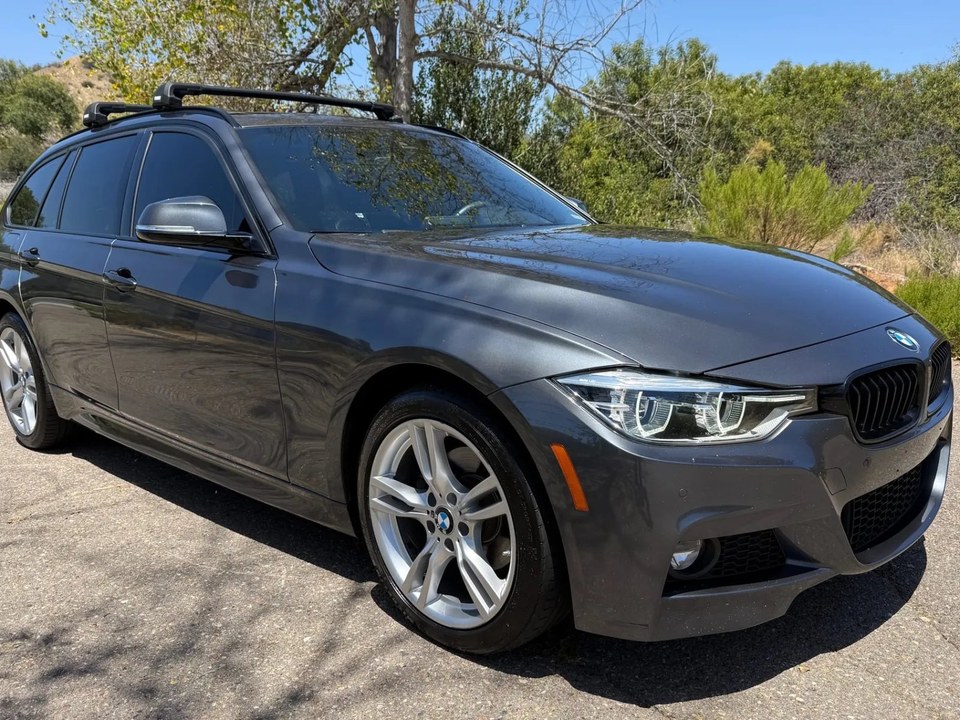
328i vs. 328d vs. 330i: which engine is actually in the wagon?
| Reference wagon | Engine code / fuel | Power / torque | Drive / transmission |
|---|---|---|---|
| 2014 328i xDrive | N20B20O0 / gasoline | 240 hp / 255 lb-ft | AWD / 8-speed automatic |
| 2014 328d xDrive | N47D20O1 / diesel | 180 hp / 280 lb-ft | AWD / 8-speed automatic |
| 2017 330i xDrive | B46B20O0 / gasoline | 248 hp / 258 lb-ft | AWD / 8-speed automatic |
| 2017 328d xDrive | N47D20O1 / diesel | 180 hp / 280 lb-ft | AWD / 8-speed automatic |
Sources: BMW’s 2014 U.S. Sports Wagon technical data and 2017 U.S. Sports Wagon technical data. These are manufacturer ratings, not a Waghoon dyno test. Confirm the actual car’s VIN and emissions label.
A search for “BMW 328 wagon” can mix two generations and two fuels. Start your shortlist with model year, body, engine and VIN. The “d” is consequential: a 328d is not a detuned gasoline 328i. Similarly, advice about an earlier six-cylinder 328i wagon should not automatically be applied to an F31 four-cylinder.
Which F31 wagon fits your use?
328i: buy the evidence behind the asking price
An earlier gasoline car can be attractive if its purchase price leaves room for known work. The useful comparison is between two documented cars, including their immediate service needs. Ask what was replaced, by whom and at what mileage; “timing done” without an invoice is an unanswered question.
328d: make the diesel case with your own numbers
The diesel offers a different torque delivery and fuel-cost calculation. BMW’s 2017 sheet identifies an SCR system with AdBlue tanks on the 328d, equipment absent from the gasoline column. Include emissions-system diagnostics and maintenance in a diesel inspection. A higher purchase price needs enough annual use and enough fuel savings to recover it; a repair bill can change that calculation quickly. BMW 2017 data.
330i: a different gasoline engine, not a maintenance exemption
The 2017 reference uses the B46 engine. Do not transfer every N20-specific warning to it, but do inspect cooling, leaks, service records and the AWD system on the actual car. The higher-output gasoline reference is also quicker in BMW’s own figures: 5.7 seconds to 60 mph for the 2017 330i versus 7.6 for that year’s 328d. Those are manufacturer results, not a promise for an aged used example. BMW performance figures.
What should you ask about the 328i timing chain?
BMW service bulletin SIB 11 03 17 identifies certain 2014–2015 F31 328i xDrive wagons with the N20 engine in a timing-chain and oil-pump-drive-chain limited warranty extension. Its model table lists production from February 26, 2013 through February 25, 2015, but the bulletin also says the table alone does not determine eligibility. BMW bulletin hosted by NHTSA.
This is a historical service bulletin, not a recall announcement or a promise of free repairs today. Have a BMW specialist check the VIN, build date, service history and any chain-system repair documentation. A cold start is useful, but absence of noise does not certify internal condition. Ask for a written inspection scope and quote for any unresolved work before negotiating.
For any of the three engines, inspect the vehicle as a wagon: panoramic-roof drainage, cargo-area moisture, tailgate and rear-glass operation, rear-seat latches and missing cargo accessories. Add a diagnostic scan, a fully warm road test and inspection of all four tires and the driveline. These are inspection priorities, not claims that every F31 has those faults.
Does the 328d save enough fuel money?
Use expected real-world MPG for your route and local fuel prices. The worksheet compares fuel only. It excludes insurance, tax, financing, depreciation, DEF, maintenance and repairs. Enter a diesel purchase premium only if you want a simple fuel-only break-even estimate.
For illustration only: at 12,000 miles, 28 gasoline MPG at $4/gallon costs about $1,714 a year. At 36 diesel MPG and $4.25/gallon, fuel costs about $1,417. That hypothetical $298 saving would take about 6.7 years to recover a $2,000 purchase premium, before other costs. These are example inputs, not measured F31 economy or current pump prices.
Why two F31 cargo numbers may disagree
BMW’s 2014 sheet lists 17.5–53 cubic feet, while the 2017 sheet labels its 27.5–61.5 figures as SAE trunk volume. Do not subtract those numbers and conclude that the later wagon gained that much physical cargo space. The references use different labels and model years. Compare exact source definitions, then measure the object and the actual car. Both sheets give a 110.6-inch wheelbase. 2014 source; 2017 source.
Use our cargo measurement worksheet for a crate, stroller or rigid case. For a manual gearbox, broaden the search carefully: the U.S. F31 reference wagons above are automatics; a manual advertisement needs its own factory-specification or conversion evidence.
Before you shortlist a car
- Record the VIN, model year, engine and transmission.
- Separate asking price from overdue maintenance and disclosed fees.
- Ask for invoices addressing the engine-specific questions above.
- Measure your cargo with the rear seat in the position you will use.
- Commission an independent inspection before committing.
Browse dated BMW wagon profiles, compare representative figures in the wagon index, or follow the full used-wagon buying checklist.
Sources and editorial method
Waghoon Editorial Team compared the manufacturer references linked next to the claims above. This is desk research and buyer guidance, not a road test or an inspection of every example. Figures keep their model-year and market labels; inspection prompts are editorial advice, not estimates of defect frequency. Read our editorial policy or report a correction.